
Anamitra Chattopadhyay
Anamitra Chattopadhyay is a senior journalist and columnist, formerly of Anandabazar Patrika and currently associated with Ei Samay. He specialises in Bangladesh affairs, South Asian politics and regional geopolitics.
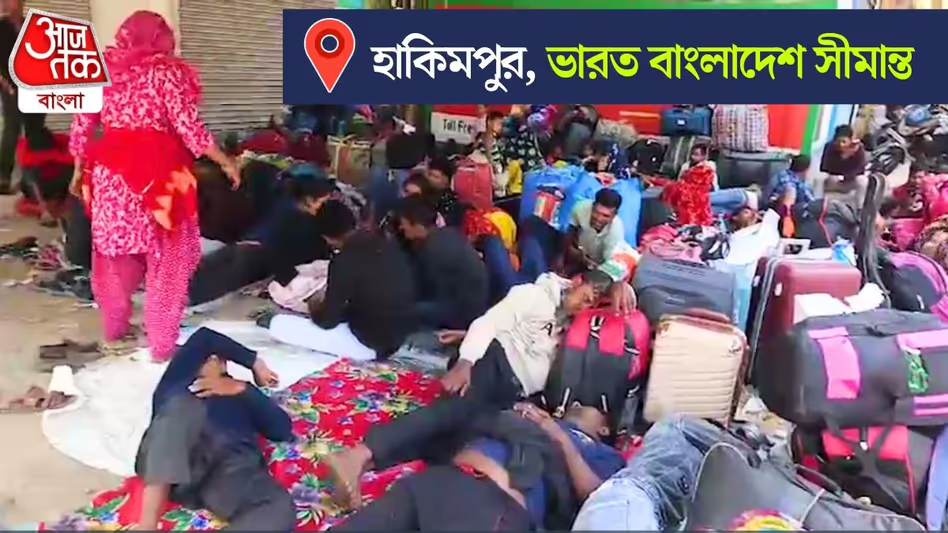
Bangladesh Faces a New Border Crisis as Dhaka Rejects Returnees Amid India’s Illegal Migration Crackdown
Bangladesh Faces a New Border Crisis as Dhaka Rejects Returnees Amid India’s Illegal Migration CrackdownA humanitarian and diplomatic standoff is unfolding along the India-Bangladesh border, where thousands of people claiming to be Bangladeshi citizens have reportedly gathered at multiple crossing points seeking to return to Bangladesh.From Hakimpur and Haridaspur to Ghojadanga, border areas have witnessed an unusual influx of men, women and children enduring extreme heat while waiting for permission to cross into Bangladesh. According to accounts gathered by journalists on the ground, many openly acknowledge that they had been living in the Indian state of West Bengal without legal immigration status.When asked about their origins, individuals reportedly identified districts such as Satkhira, Khulna, Barishal, Chattogram and Cumilla as their hometowns in Bangladesh. Asked where they had been living in India, responses ranged from Barrackpore, Dum Dum and Barasat to Sonarpur and Baruipur.Many described working in construction, agriculture, vegetable trading and marble installation, while women commonly reported employment as domestic workers. Several stated that they had lived in India for periods ranging from four to ten years after entering through irregular routes.Many cited growing concerns over immigration enforcement and the changing political climate in India as reasons for deciding to leave voluntarily. According to their accounts, they feared detention and possible imprisonment if discovered by authorities.Most of those interviewed reportedly possessed Bangladeshi National Identity Cards or birth certificates but did not hold passports. Their inability to provide regular travel documentation has further complicated efforts to establish their legal status and facilitate their return.A Growing Humanitarian ChallengeReports suggest that thousands of individuals have accumulated near border gates during the past week. Indian authorities and border security personnel have reportedly arranged temporary accommodation, food and drinking water in holding facilities while awaiting a resolution.In several cases, individuals have reportedly remained stranded in or near no-man’s land after Bangladesh border authorities declined to open crossing points.The situation has raised concerns about the emergence of a refugee-like humanitarian crisis, despite the fact that many of those gathered insist they are attempting to return to their country of origin rather than seeking asylum elsewhere.Dhaka’s PositionBangladesh maintains that it will not accept any individual without formal nationality verification through established legal procedures.Officials in Dhaka argue that nationality cannot be determined solely on the basis of claims made at the border and have expressed concerns that some individuals presented as Bangladeshis could in fact be Indian nationals.The Bangladeshi government has repeatedly stated that any repatriation process must be conducted jointly, with proper verification and legal documentation. Authorities have also objected to what they describe as unilateral attempts to transfer undocumented individuals across the border.Bangladesh has reportedly communicated this position to Indian authorities through diplomatic channels and has reiterated its opposition to any form of forced transfer.India’s Frustration Over Verification DelaysIndian officials, however, have long complained about delays in receiving confirmation from Bangladesh regarding the nationality of detained individuals suspected of being Bangladeshi citizens.According to statements made by India’s Ministry of External Affairs, verification requests in some cases have remained unresolved for years, complicating deportation and repatriation procedures.The disagreement highlights a longstanding challenge in India-Bangladesh migration management: how to identify, verify and repatriate undocumented migrants while respecting legal procedures and human rights obligations.A Test for Bilateral RelationsThe current standoff presents a significant test for both governments.For India, the issue concerns the enforcement of immigration laws and the repatriation of undocumented migrants. For Bangladesh, the concern is ensuring that only verified citizens are accepted through a lawful process.Yet beyond the diplomatic dispute lies a pressing humanitarian question: what happens to thousands of people who claim Bangladeshi citizenship, wish to return to Bangladesh, but find themselves unable to cross the border?Until a mutually agreed verification mechanism is implemented more efficiently, the border risks becoming the stage for a prolonged humanitarian crisis—one that could further strain relations between two neighbours whose cooperation remains critical to regional stability and migration management.
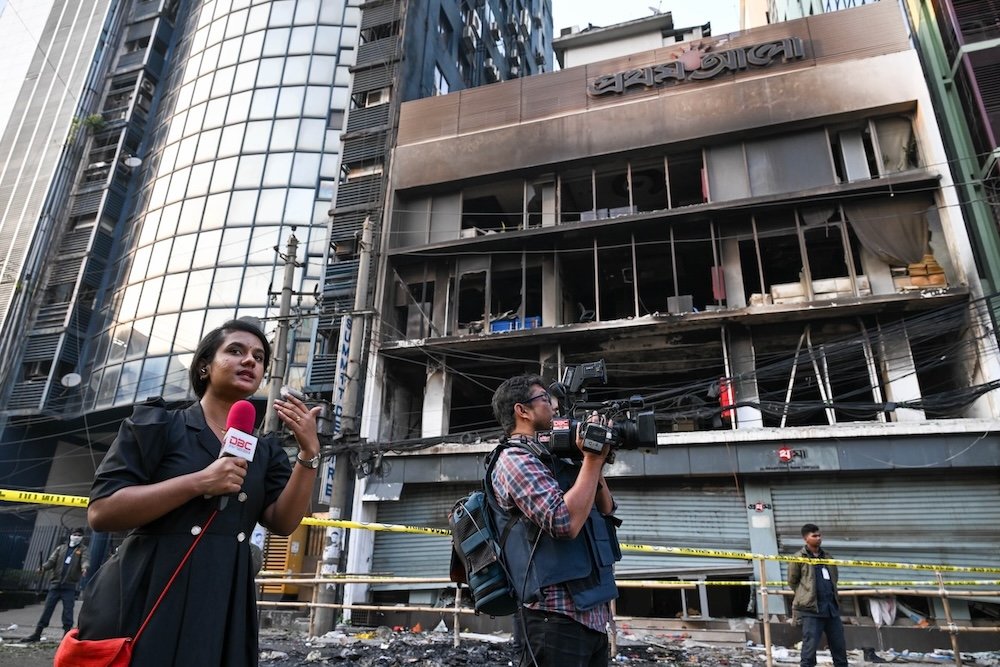
Unprecedented Persecution of Journalists Under Yunus; Calls Grow for Nobel Prize to Be Revoked
Anamitra Chattopadhyay | India | The record of journalist persecution that has emerged from the period of Muhammad Yunus\'s rule is nothing short of shocking.Unprecedented Persecution of Journalists Under Yunus; Calls Grow for Nobel Prize to Be RevokedThe record of journalist persecution that has emerged from the period of Muhammad Yunus\'s rule is nothing short of shocking.As head of Grameen Bank, he was awarded the Nobel Peace Prize. Many critics have long argued that Muhammad Yunus is the architect of a business model that profits by trapping the poorest people in poor countries in cycles of high-interest debt. Ever since that model received international recognition through the Nobel Prize, aided, according to critics, by the direct intervention of influential friends in the United States, controversy has surrounded both the award and the model itself. After 18 months of governing Bangladesh, Yunus\'s actions have also come under intense scrutiny. His government suspended the country\'s vaccination programme. As a result, with herd immunity shattered, the number of child deaths from measles is reportedly approaching 600, while infections have surpassed one hundred thousand. Now, the record of journalist persecution under Yunus that has come to light is equally alarming. Many are demanding that the Nobel authorities revoke Yunus\'s Nobel Prize over what they describe as grave human rights violations. After the departure of the Yunus government, journalists who had found themselves cornered, regardless of political affiliation, formed an organisation called the Anti-Persecution Journalists Front. Bringing together information from across the country, the organisation has compiled and published a detailed account of the alleged persecution. According to the report, the Yunus government implicated more than 500 journalists in what it describes as fabricated criminal cases carrying severe charges, including murder. A statement issued by the organisation says: \"More than fifty journalists were arrested. Thirteen journalists were killed. In addition, around 1,200 journalists lost their jobs. Government accreditation cards of 168 professional journalists were revoked. Memberships of more than 700 journalists were cancelled or suspended by various press clubs, including the National Press Club.\" Officials of the organisation state that during Yunus\'s tenure, 47 journalists across the country were arrested, including Shahriar Kabir, Mozammel Babu, Shyamal Dutta, Shakil Ahmed, Farzana Rupa, Sheikh Jamal, Manjurul Alam Panna and Anis Alamgir. Only a small number of them have since been released on bail. The organisation further alleges that 13 journalists, including Mehedi Hasan, Shakil Hossain, Tahir Zaman, ATM Turab, Pradip Kumar Bhowmik and Sohel Akhanji, were killed.The Anti-Persecution Journalists Front also states that supporters of Yunus were responsible for acts of vandalism, attacks and arson targeting the offices of BTV, 71 TV, Somoy TV, DBC News, Gaan Bangla, ATN News, ATN Bangla, My TV, Bijoy TV, News24, and the newspapers Amader Orthoniti, Amader Notun Shomoy, Dainik Mukhopatro, Kaler Kantho, Bangladesh Pratidin, Daily Sun, Bangla News, Prothom Alo and The Daily Star. According to the statement, editors, news chiefs and journalists from various media organisations were subjected to pressure, resulting in the dismissal of approximately 1,200 journalists during Yunus\'s administration. Recently, journalists took to the streets of Dhaka, forming a human chain and demanding the withdrawal of all false cases filed against them. They called for the release of imprisoned journalists, justice for murdered journalists, reinstatement of those who lost their jobs, and the reopening of the offices of the two journalist organisations, DUJ and BFUJ. They also demanded justice for looting and arson attacks on newspaper offices, restoration of memberships cancelled by press clubs across the country, including the National Press Club, reversal of accreditation card cancellations, withdrawal of orders freezing journalists\' bank accounts, and removal of restrictions imposed on their foreign travel. Many campaigners are now characterising the organised persecution of journalists as a serious violation of human rights and are calling on the Nobel authorities to revoke Yunus\'s Nobel Prize. They argue that allowing such a ruler to continue being identified as a Nobel laureate damages the reputation and moral standing of the award itself. The BNP government led by Tarique Rahman recently completed its first 100 days in office after winning the election. Although no new cases or attacks against journalists have been reported under the current administration, the cases filed during Yunus\'s tenure have not yet been withdrawn. Police have reportedly failed to submit charge sheets against imprisoned journalists even after 18 to 20 months. Despite this, they have not been granted bail. In many instances, journalists who secured bail in existing cases have allegedly been implicated in new cases and kept behind bars. During a meeting with editors, Prime Minister Tarique Rahman assured media representatives that his government does not believe in suppressing or controlling the press. He also promised to review the cases filed against journalists. However, according to critics, none of these commitments have been implemented during the government\'s first 100 days. Akhtar Hossain, Convenor of the Anti-Persecution Journalists Front, said: \"The responsibility for releasing journalists imprisoned during the Yunus era and ending the persecution of journalists now lies with the current government. If it fails to fulfil that responsibility, it will be assumed that it has taken a position against journalists. Public expectations from a political government are high. Please free the journalists." Anamitra Chattopadhyay is a senior journalist and columnist, formerly of Anandabazar Patrika and currently associated with Ei Samay. He specialises in Bangladesh affairs, South Asian politics and regional geopolitics. Editorial note for PolicyGov: "The views expressed in this article are those of the author. The allegations cited are based on claims made by the Anti-Persecution Journalists Front and have not been independently verified by PolicyGov."